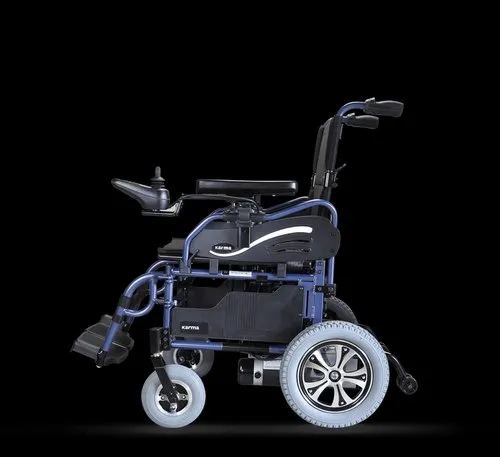
The global demand for Electric Power Wheelchair technology has experienced a structural paradigm shift driven by demographic aging, expanding hospital infrastructure, and enhanced clinical standards for patient autonomy. Once considered specialized assistive devices for severe spinal cord injuries or progressive neurological disorders, modern power wheelchairs are now engineered as dynamic mobility platforms. They integrate advanced drivetrain mechanics, ergonomics, electronic joystick management, and high-energy-density power cells to provide reliable, long-range transport across diverse indoor and outdoor environments.
For international healthcare procurement teams, medical equipment distributors, and institutional buyers, sourcing an Electric Power Wheelchair requires evaluating parameters beyond simple mobility. Key considerations include mechanical structural integrity, motor torque capacity under variable incline gradients, electronic controller responsiveness, battery safety compliance (such as UN38.3 for lithium shipping), and long-term total cost of ownership (TCO). Procurement managers must balance patient safety, operator ergonomics, maintenance cycles, and OEM customization capabilities when establishing supply chain partnerships with certified medical device manufacturers.
Engineering & Technical Architectural Standards
A commercial-grade Electric Power Wheelchair relies on an integrated electromechanical architecture where structural metallurgy, drivetrain propulsion, and microprocessor controller logic function as a cohesive system. Below is a deep-dive technical breakdown of the architectural components engineered into commercial power wheelchairs manufactured by Singar Rehab:
1. Structural Frame Metallurgy & Dynamic Weight Ratings
The chassis serves as the foundation for load distribution, structural rigidity, and collision absorption. Premium power wheelchairs utilize high-tensile grade 304/316 stainless steel alloys or aerospace-grade T6-6061 aluminum tubing. Stainless steel frames provide exceptional torsional resistance, heavy-duty payload stability (rated for up to 125 kg – 150 kg), and superior resilience against environmental corrosion in humid or coastal clinical settings. Structural joints are precision TIG-welded to mitigate stress-fatigue microcracks under continuous dynamic loads.
2. Drivetrain Propulsion: Brushless DC (BLDC) vs. Brushed Motors
The propulsion efficiency of an Electric Power Wheelchair depends directly on motor selection. Singar Rehab incorporates dual high-torque 250W to 350W electromagnetic motors. High-efficiency Brushless DC (BLDC) motors feature gearless or planetary gearbox transmission systems, yielding operational noise levels below 55 dB, minimal brush wear maintenance, and energy conversion efficiencies exceeding 85%. These dual-motor configurations provide independent wheel drive, enabling 360-degree zero-radius turning maneuverability essential for tight hospital corridors and home doorways.
3. Electronic Intelligent Joystick Controllers
Patient control interfaces leverage proportional 360-degree micro-switch joystick controllers, such as industry-standard PG Drives Technology or VSI system controllers. The microprocessors handle dynamic acceleration curves, anti-rollback incline logic, speed adjustment presets (typically 1 km/h to 8 km/h), and instantaneous diagnostic error messaging. Integrated electro-magnetic regenerative braking systems engage automatically when the joystick returns to neutral, holding the wheelchair stationary on slopes up to 12 degrees without manual lever intervention.
4. Energy Storage Architecture: LiFePO4 vs. Sealed Lead-Acid (SLA)
Energy storage dictates range performance, total operational weight, and freight logistics. Modern commercial fleets are shifting toward Lithium Iron Phosphate (LiFePO4) chemistry due to its thermal stability, 2,000+ deep-discharge cycle life, and rapid charge capability. However, Sealed Lead-Acid (SLA / AGM 12V 24Ah/35Ah) configurations remain a cost-effective, robust choice for heavy-duty institutional fleets where low initial capital expenditure and strict non-spillable battery compliance are paramount.
| Technical Parameter |
Standard Duty Power Wheelchair |
Heavy-Duty Commercial Variant |
Clinical & Sourcing Advantage |
| Frame Construction |
Heavy-Duty Steel / Aluminum Alloy |
Reinforced Grade 304 Stainless Steel |
Maximum structural rigidity; corrosion resistance. |
| Motor Specifications |
Dual 250W Brushed / BLDC Motors |
Dual 350W Heavy-Torque BLDC Motors |
High incline climbing (up to 12°) & silent operation. |
| Controller Technology |
360° Proportional Micro-Joystick |
Programmable PG Drives / VR2 System |
Smooth acceleration curves and emergency braking. |
| Maximum Weight Capacity |
100 kg – 110 kg |
125 kg – 160 kg (Bariatric compatible) |
Accommodates diverse patient demographics. |
| Battery System & Range |
24V 12Ah Lithium / 24Ah SLA (15–20 km) |
24V 30Ah–40Ah Lithium (25–35 km) |
Extended operation between charge cycles. |
| Braking Mechanism |
Electromagnetic Intelligent Auto-Brake |
Dual Electromagnetic + Manual Parking Lock |
Fail-safe parking on gradients; zero back-roll. |