Expert articles, patient care guides, and technical innovations in artificial limbs and orthotics.
Explore ArticlesUnderstanding gait correction, foot-drop rehabilitation, and custom AFO orthoses technology.
Read ArticleErgonomic designs and powered mobility solutions empowering patient independence worldwide.
Read ArticleComprehensive guides on amputation level solutions, socket fitting, and bio-mechanical alignment.
Read ArticleClinical approaches to post-operative recovery, diabetic foot care, and orthopaedic footwear.
Read ArticleAdvanced structural stabilization and full-body postural rehabilitation methods.
Read ArticleIdentifying a top China Hip Abduction Orthosis manufacturer requires more than comparing prices or reading polished catalogs. The strongest suppliers combine practical manufacturing experience, clinical awareness, and consistent quality control. They understand that an orthosis is not merely a molded device. It supports a patient’s position, comfort, mobility, and daily confidence.
Look closely at the details. Can the manufacturer explain its hip angle options, size range, and adjustment process? Do technicians check hinge movement, strap strength, padding thickness, and surface finish? A reliable factory should provide clear product specifications, inspection records, material information, and traceable batch details. Photos of a production line help, but direct communication and sample evaluation reveal more. A sample should fit securely without creating sharp pressure around the pelvis or thighs. Small details matter.
Experience also appears in the questions a supplier asks. A professional team will request measurements, intended use, user age, and fitting conditions before recommending a model. It should also explain limitations honestly and support reasonable customization. No manufacturer is flawless. That deserves attention. Overconfident claims can be less reassuring than a documented improvement plan.
This guide examines how to assess leading Chinese manufacturers through design capability, production discipline, product testing, communication, and after-sales reliability. Certifications may support credibility, but they should not replace evidence. A dependable partner earns trust through repeatable results, responsive service, and products that perform beyond the showroom. That is the real standard.
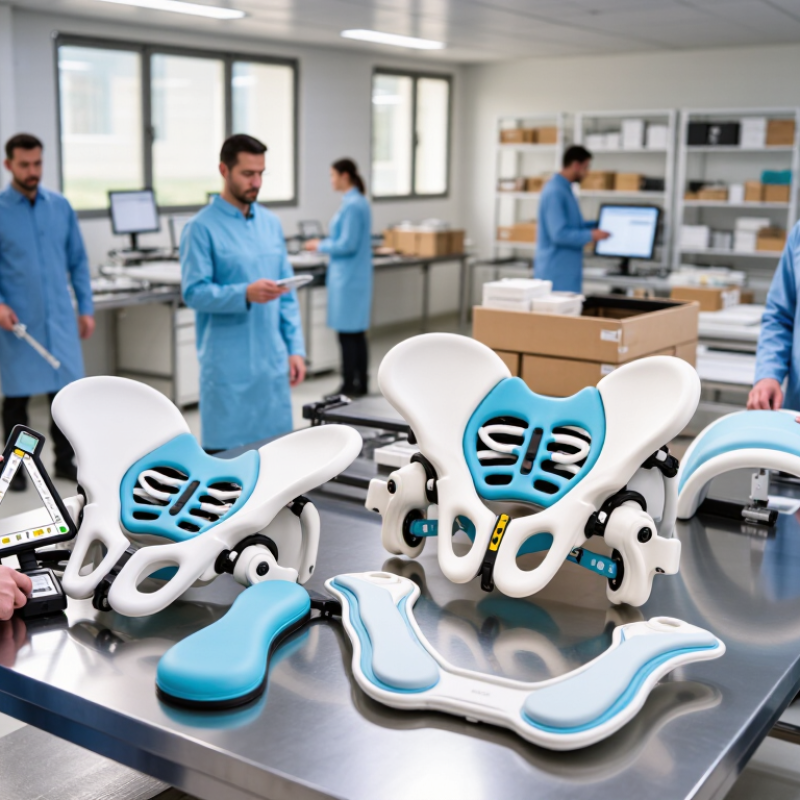
A capable China hip abduction orthosis manufacturer should provide more than a polished product sample. ISO 13485 shows that the company controls design, production, complaints, and corrective actions through a medical device quality system. It also supports traceability. Each strap, hinge, pad, and molded component should connect to documented inspection records.
ISO 10993 focuses on biological safety, not general product performance. For an orthosis touching skin, the manufacturer should assess materials according to contact type and duration. Testing may examine irritation, sensitization, cytotoxicity, and chemical risks. Foam, adhesives, plastics, and fabric deserve separate attention. A comfortable surface can still cause problems after repeated wear.
Ask for controlled test reports, material specifications, and risk-based evaluation records. The factory should explain how it handles supplier changes, production deviations, and sterilization or cleaning requirements. In practical audits, small details matter. Check whether batch numbers remain readable after packaging and transport. Review how complaints are investigated.
Certification alone is not enough. I have seen teams trust documents without checking whether the tested material matches current production. That gap is easy to overlook. A stronger assessment combines ISO 13485 records, relevant ISO 10993 evidence, process observations, and samples from normal production. Some manufacturers may lack perfect documentation at first. Their response to questions often reveals more than the certificate itself.
A top China hip abduction orthosis manufacturer should prove more than production capacity. It should show repeatable 30°–45° abduction settings, clear adjustment markings, and documented pediatric fitting experience. A 30° position may support early positioning, while 45° can create more space during selected clinical protocols. However, the correct angle depends on diagnosis, hip stability, age, and clinician assessment. More is not always better.
Pediatric size coverage must match real growth, not just marketing charts. The CDC’s Autism and Developmental Disabilities Monitoring Network reported cerebral palsy prevalence of 3.4 per 1,000 eight-year-old children in 2019. This reinforces the need for adaptable devices across infancy, early childhood, and school age. A reliable manufacturer should provide measured size ranges, soft interface options, adjustable pelvic supports, and traceable quality records. ISO 13485-based quality systems can support consistent medical-device production, but certification alone does not guarantee comfort.
Practical testing matters. The orthosis should remain stable when a child kicks, rolls, or sits. Straps should be easy for caregivers to identify at night. Small details matter. Yet a neat angle chart does not prove clinical success. I would ask for fit-test records, material safety data, hinge-cycle testing, and feedback from pediatric therapists. The International Hip Dysplasia Institute emphasizes careful hip positioning, but prescribed angles should never be copied without assessment. Manufacturers that openly report limitations may deserve more trust than those promising universal results.
Who Is a Top China Hip Abduction Orthosis Manufacturer?
A reliable hip abduction orthosis manufacturer should explain its market authorization clearly. For European sales, verify CE marking under the Medical Device Regulation. Request the Declaration of Conformity, certificate details, and intended-purpose statement. These documents should match the actual device, packaging, and instructions. A certificate alone is not enough. Check the notified body and certificate scope carefully. For the United States, confirm the FDA 510(k) clearance and compare its product code, indications, and device description. Clearance does not mean universal approval. It supports a specific intended use.
Tips: Ask for a redacted technical file index, risk-management evidence, clinical evaluation information, and post-market surveillance procedures. Check whether the UDI appears on the label, packaging, and required database records. Scan the barcode on a sample box. Then compare the result with the model number and manufacturer details. Small mismatches matter.
Practical experience reveals another checkpoint: inspect hinges, straps, padding, and adjustment markings on production samples. The authorized configuration should match the cleared or declared configuration. Ask how design changes are controlled after certification. Some suppliers provide impressive documents but answer slowly when evidence becomes specific. That is a warning sign, though not absolute proof. Regulatory status can also change, so verify current records before purchase. Independent review by a qualified regulatory professional adds confidence, especially when selling across multiple markets.
| Verification Dimension | What Should Be Verified | Objective Evidence | Public or Regulatory Check | Assessment Indicator |
|---|---|---|---|---|
| Product intended purpose | The device is specifically intended to position or limit hip movement, such as maintaining hip abduction after surgery or during rehabilitation. | Consistent intended-purpose statement, indications, contraindications, user population, and application instructions. | Compare the intended purpose across the technical file summary, label, instructions for use, declaration, and regulatory listing. | All documents describe the same device function without broader unsupported medical claims. |
| EU CE marking under MDR | The product follows Regulation (EU) 2017/745 when placed on the European Union market, where applicable. | EU Declaration of Conformity, MDR-compliant labeling, risk-management documentation, clinical evaluation, and applicable conformity-assessment records. | Check the notified body certificate when third-party assessment is required and confirm the certificate scope, validity, manufacturer, and device family. | The certificate and declaration cover the exact product or an explicitly defined product family; expired or unrelated certificates are not sufficient. |
| EU MDR device classification | Classification is determined by the device’s intended purpose, duration of use, invasiveness, active or non-active status, and applicable MDR rules. | Documented classification rationale that identifies the applied MDR classification rule and supporting risk analysis. | Review the classification in the declaration, technical documentation, and notified body scope where relevant. | A credible manufacturer explains why the classification applies instead of relying only on a generic class label. |
| EU Authorized Representative | A manufacturer located outside the European Union generally requires a single EU Authorized Representative for devices placed on the EU market. | Authorized Representative name and address shown on the label, packaging, or accompanying documentation. | Verify that the representative’s details are consistent across the label, declaration, registration records, and commercial documents. | Missing, inconsistent, or unverifiable representative information requires clarification before purchase. |
| FDA 510(k) status | A 510(k) is relevant only when the device requires a U.S. premarket notification and has a legally marketed predicate device. | FDA 510(k) number, decision date, applicant or manufacturer details, product code, and cleared indications that match the offered device. | Search the FDA 510(k) Premarket Notification database and review the complete decision summary, not only a certificate image. | A “registered” or “listed” facility is not the same as a device being 510(k)-cleared. |
| FDA establishment registration and listing | For products marketed in the United States, the responsible establishment and device listing should be reviewed separately from premarket clearance. | Current establishment registration and device listing information associated with the actual legal manufacturer or specification developer. | Check the FDA Establishment Registration and Device Listing database and compare the listed address and device details with supplier documents. | Registration and listing support market participation but do not independently prove 510(k) clearance or product performance. |
| UDI and device traceability | The device should have an applicable Unique Device Identifier structure, including a device identifier and production identifier where required. | UDI-DI, package-level identifiers, lot or batch information, serial or expiration data when applicable, and readable barcode or data carrier. | Search the FDA Global UDI Database when the product is subject to U.S. UDI requirements; compare the record with the physical label. | The identifier, product description, packaging level, and manufacturer information should match the supplied product. |
| Quality management system | A medical-device quality system should control design, purchasing, production, complaints, nonconformities, corrective actions, and change management. | Current quality-management certificate, audit scope, manufacturing site, certificate validity, and applicable medical-device standard or regulatory framework. | Confirm certificate authenticity with the issuing certification or accreditation body where verification is available. | The certified site and scope should cover the design or manufacturing activities relevant to the orthosis. |
| Clinical and performance evidence | Evidence should support the claimed function, fit, adjustment range, mechanical performance, usability, and foreseeable risks for the intended users. | Clinical evaluation or equivalent evidence, bench testing, mechanical testing, usability records, and rationale for material and padding safety. | Request controlled reports with test methods, sample identification, acceptance criteria, results, and laboratory details. | Evidence should relate to the exact model, materials, size range, and intended purpose rather than a visually similar product. |
| Labeling and instructions for use | Labels and instructions should identify the device, manufacturer, model, lot or serial information, intended use, warnings, fitting method, cleaning, and maintenance. | Controlled label artwork, instructions for use, packaging specification, symbols, language versions, and revision history. | Compare the documents with the physical sample and with the regulatory submission or declaration. | Missing warnings, unclear sizing, inconsistent model numbers, or unsupported therapeutic claims are significant concerns. |
| Post-market surveillance | The manufacturer should monitor complaints, incidents, returns, adverse events, corrective actions, and field safety issues. | Complaint procedure, vigilance process, trend reports, corrective-action records, and a defined contact for regulatory incidents. | Review applicable safety notices, recall databases, and the manufacturer’s documented corrective-action process. | A responsive system for handling complaints is a stronger indicator than marketing claims or a certificate alone. |
| Supply-chain and change control | The legal manufacturer, design owner, contract manufacturer, importer, and distributor roles should be clearly defined. | Supplier agreements, approved-component records, change-notification procedure, batch records, and certificates of conformity. | Compare legal entities and manufacturing addresses across regulatory records, invoices, labels, and quality documents. | Uncontrolled changes to materials, hinges, straps, padding, or production location may invalidate prior evidence. |
A top China hip abduction orthosis manufacturer should prove more than production capacity. Lead time must be measured from approved drawings to shipment, not from a sales promise. A practical OEM target is 10–15 working days for a repeat batch, with tooling and material approval listed separately. This distinction prevents a common mistake: calling unfinished inventory “fast delivery.”
MOQ also requires context. A 50-piece MOQ may suit pilot testing, while a 500-piece MOQ can reduce unit cost but increase storage risk. The 2020 Global Supply Chain Resilience Survey reported supplier disruption across 73% of surveyed companies, showing why flexible replenishment matters. Buyers should request MOQ by component, not only by finished orthosis. Small batches expose weak processes.
Traceability is less visible, but more important. ISO 13485:2016 requires controlled records throughout medical-device production. FDA UDI guidance identifies lot, batch, serial, and expiration data as key production identifiers. A reliable factory should link each batch to material certificates, operator checks, molding parameters, inspection photos, and shipment cartons. Ask for a sample traceability file. Really inspect it. In our experience, some documents look complete until one buckle or foam lot cannot be traced backward. That gap needs correction before scale-up, not after a complaint.
A strong manufacturer should prove fit accuracy beyond catalog measurements. In clinical practice, pelvic width, thigh angle, and hinge alignment can change within one fitting session. Skilled orthotists should record these values and repeat them after movement testing. A useful design keeps the femoral head positioned correctly without forcing the child into an unnatural posture. Fit is not a showroom impression. It is measured, adjusted, and reviewed.
Skin pressure deserves equal attention. A well-made orthosis should spread contact across the pelvis and thighs, rather than concentrate force near the groin or brace edges. Clinicians can inspect redness after removal and document pressure-related complaints. Pressure-mapping tools may add stronger evidence, although they are not available in every clinic. Material softness helps, but it cannot replace correct alignment. Small gaps can become large problems during sleep.
Revision rates reveal what happens after delivery. Manufacturers should track remakes, strap failures, growth-related adjustments, and clinical non-compliance. A low revision rate matters only when definitions are transparent and follow-up periods are consistent. I would question any supplier reporting perfect outcomes. Real patients grow, resist treatment, and sometimes need redesigns. Independent testing, clinician feedback, and traceable production records provide more confidence than polished claims. The most reliable supplier supports fitting education and responds quickly when early skin marks or alignment concerns appear.
A reliable device may offer adjustable settings between 30° and 45°. The correct angle depends on diagnosis, age, hip stability, and clinical assessment. More is not always better. Measure twice.
Clear markings help clinicians and caregivers repeat the prescribed position accurately. They also reduce mistakes during nighttime adjustments. The markings should remain visible after regular cleaning and use.
Sizes should cover infancy, early childhood, and school age. Measured pelvic and thigh ranges matter more than attractive size charts. Adjustable pelvic supports and soft interfaces can improve fit during growth. Growth changes everything.
The orthosis should remain stable when a child kicks, rolls, or sits. Testing should include straps, hinges, padding, and adjustment points. A device that looks stable on a table may shift during sleep.
Clinicians should record pelvic width, thigh angle, and hinge alignment. They should repeat these measurements after movement testing. Fit requires adjustment and review, not just a showroom inspection.
Contact should spread across the pelvis and thighs. Pressure should not concentrate near the groin or brace edges. Caregivers can check redness after removal and report lasting marks quickly. Small gaps hurt.
Request fit-test records, material safety information, hinge-cycle results, and traceable production records. The supplier should also explain design-change controls and complaint handling. Certification helps, but it does not guarantee comfort.
Ask for current authorization documents matching the device, packaging, instructions, and intended use. Check the certificate scope and product details carefully. The identification code on a sample box should match the model record. Small mismatches matter.
Revision data may show strap failures, growth adjustments, remakes, and treatment difficulties. Ask about definitions and follow-up periods before trusting low rates. Perfect outcomes sound doubtful. Real children grow and resist treatment.
Open reporting, responsive fitting support, and clinician feedback are useful signs. A supplier should admit design limits instead of promising universal results. I would still verify the evidence independently.
Choosing a top China Hip Abduction Orthosis manufacturer requires evaluating quality, safety, regulatory readiness, and clinical performance rather than relying on product appearance alone. ISO 13485 certification indicates a structured medical device quality system, while ISO 10993 testing helps assess the biocompatibility of materials that contact the skin. A capable manufacturer should also provide reliable 30°–45° abduction settings, accurate adjustment mechanisms, and pediatric size coverage for different stages of growth.
Market authorization is another essential consideration. Buyers should verify CE MDR documentation, FDA 510(k) status when applicable, and UDI capabilities for product identification and traceability. OEM evaluation should include lead time, MOQ flexibility, production capacity, and batch-level records. Finally, clinical metrics such as fitting accuracy, skin pressure distribution, wearer comfort, and revision rates can reveal how consistently the orthosis performs in practice. A manufacturer that combines documented compliance, responsive customization, and measurable clinical outcomes is better positioned to deliver dependable Hip Abduction Orthosis solutions.