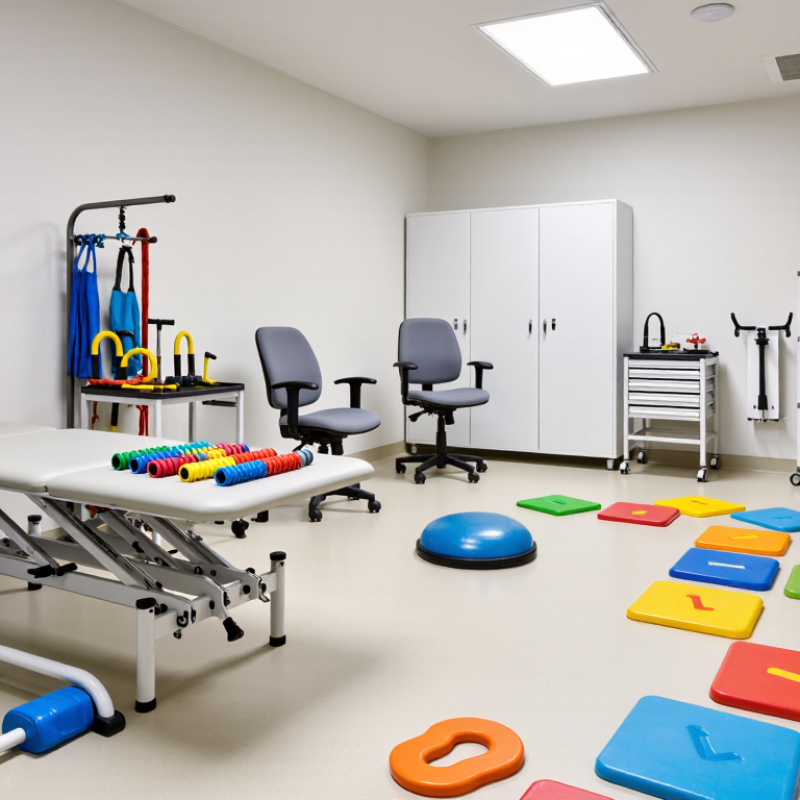
| Height-Adjustable Treatment Tables |
Transfers, positioning, dressing practice, manual therapy, functional assessments, and task simulation. |
Electric or hydraulic height adjustment; common working-height range of approximately 45–95 cm; padded sections; working load commonly rated above 180 kg. |
Ergonomic care
More clinics are prioritizing therapist injury prevention, accessible transfers, and flexible treatment environments. |
Adults with neurological, orthopedic, geriatric, and mobility-related conditions. |
Low minimum height, stable frame, lockable casters, easy-clean upholstery, transfer clearance, and emergency-stop access where powered adjustment is used. |
| Dynamic Standing and Weight-Bearing Systems |
Supported standing, postural control, lower-limb loading, reaching, and participation in functional activities. |
Adjustable support points; pelvic and trunk supports; foot plates or knee blocks; some systems accommodate progressive angle or height changes. |
Active rehabilitation
Clinics are combining supported mobility with task-oriented and participation-focused therapy. |
People with cerebral palsy, spinal cord injury, stroke, multiple sclerosis, and significant motor impairments. |
Weight capacity, harness compatibility, quick-release mechanisms, pressure distribution, alignment adjustment, and two-person transfer procedures when required. |
| Upper-Extremity Exercise and Fine-Motor Stations |
Range of motion, graded strengthening, coordination, bilateral use, dexterity, and hand-function training. |
Interchangeable handles or pegs; adjustable resistance; measurable repetitions or time; task surfaces at different heights and angles. |
Modular therapy
Compact, reconfigurable stations support individualized programs while reducing room footprint. |
Patients recovering from stroke, hand injury, arthritis, tendon repair, and neurological conditions. |
Resistance adjustability, smooth movement, neutral wrist options, replaceable components, cleaning access, and compatibility with splints or orthoses. |
| Sensor-Based Hand-Function Assessment Tools |
Measurement of grip force, pinch force, repetition, movement speed, and task performance. |
Digital or mechanical force measurement; grip and pinch testing; repeatable protocols; data export may be available on connected models. |
Data-informed care
Objective metrics are increasingly used to document progress and support goal-based treatment planning. |
Patients with hand trauma, arthritis, neurological disorders, and work-related upper-limb conditions. |
Calibration process, measurement repeatability, clinically appropriate test positions, hygienic contact surfaces, and secure handling of patient data. |
| Virtual-Reality and Interactive Cognitive Systems |
Visual-motor training, attention, sequencing, simulated daily activities, balance-related tasks, and graded participation. |
Head-mounted or screen-based interaction; adjustable task difficulty; session duration tracking; optional motion or hand controllers. |
Immersive therapy
Interactive digital tasks are being used to increase engagement and provide repeatable, graded practice. |
Patients with stroke, traumatic brain injury, neurological conditions, developmental needs, and age-related cognitive changes. |
Motion-sickness screening, field-of-view safety, seated alternatives, hygiene covers, accessibility controls, supervision, and privacy safeguards. |
| Sensory Integration and Regulation Equipment |
Proprioceptive, vestibular, tactile, and self-regulation activities within a structured therapeutic plan. |
Suspension points, crash mats, swings, balance surfaces, tactile materials, and adjustable activity intensity. |
Trauma-informed design
Clinics are emphasizing predictable environments, patient choice, sensory load management, and safer graded exposure. |
Children and adults with sensory-processing differences, autism, developmental disabilities, and regulation difficulties. |
Anchoring and inspection procedures, fall-zone clearance, load ratings, washable materials, visual overstimulation control, and individualized sensory assessment. |
| Task-Specific ADL and IADL Training Units |
Cooking, dressing, bathing, medication management, work simulation, home safety, and community-living skills. |
Adjustable work surfaces; simulated cabinets, sinks, appliances, or bathroom fixtures; modular handles and environmental barriers. |
Participation-focused care
Equipment is increasingly designed around real-life occupations rather than isolated body functions. |
People recovering from neurological injury, older adults, individuals with disabilities, and patients preparing for discharge. |
Accessibility, realistic task demands, anti-scald and electrical safety, easy cleaning, transfer space, and compatibility with assistive devices. |
| Assistive Technology Assessment Kits |
Trial and selection of equipment for communication, mobility, computer access, environmental control, and daily living. |
Switches, alternative keyboards, mounts, access interfaces, adapted utensils, reachers, and environmental-control samples. |
Personalized access
Clinics are using rapid trials and modular components to match technology to individual motor, cognitive, and sensory profiles. |
Patients with neurological, developmental, musculoskeletal, and progressive conditions. |
Interoperability, adjustability, repairability, training requirements, caregiver usability, device security, and long-term support availability. |
| Robotic and Electromechanical Assistive Devices |
Repetitive upper-limb practice, movement assistance, grasp-and-release training, and task-specific motor rehabilitation. |
Adjustable assistance levels; programmable repetitions; movement limits; session logs; some systems provide visual performance feedback. |
Dose optimization
Technology is being used to deliver consistent, repeatable practice while allowing therapist-directed personalization. |
Patients with stroke, spinal cord injury, traumatic brain injury, and other motor impairments. |
Clinician override, emergency stop, fit and alignment, device-specific contraindications, maintenance, cybersecurity, and evidence for the intended population. |
| Portable Mobility and Transfer Training Equipment |
Bed-to-chair transfers, sit-to-stand practice, gait-related tasks, wheelchair skills, and caregiver training. |
Transfer boards, sit-to-stand aids, gait belts, mobile lifts, step platforms, and adjustable support handles. |
Safe transitions
Portable systems support decentralized treatment, home-transition preparation, and safer caregiver education. |
Older adults and patients with weakness, balance impairment, amputation, stroke, or reduced endurance. |
Rated load, brake performance, sling or belt fit, floor compatibility, staff training, infection control, and documented transfer protocols. |
| Pressure-Mapping and Seating Assessment Tools |
Wheelchair seating, posture analysis, pressure redistribution, positioning, and skin-integrity risk management. |
Sensor mats or pressure-sensitive interfaces; visual pressure maps; posture observation; repeatable seating positions. |
Preventive monitoring
More clinics are integrating objective seating data with individualized positioning and prevention plans. |
Wheelchair users and patients with limited mobility, reduced sensation, or high pressure-injury risk. |
Sensor repeatability, calibration, software usability, seating compatibility, data protection, cleaning method, and clinical interpretation by trained staff. |
| Portable Vital-Sign and Activity Monitoring Devices |
Monitoring tolerance during therapy, documenting activity, and supporting graded participation. |
Depending on device: heart rate, oxygen saturation, blood pressure, step count, activity duration, or perceived-exertion documentation. |
Connected workflows
Portable monitoring can support timely adjustment of exercise intensity and more consistent session documentation. |
Patients with cardiopulmonary limitations, deconditioning, neurological conditions, and reduced endurance. |
Clinical accuracy, appropriate alarm thresholds, skin-contact hygiene, battery management, patient consent, and compliance with local monitoring protocols. |
| 3D Scanning and Digital Fabrication Tools |
Custom splinting, positioning supports, adaptive grips, orthotic prototypes, and individualized equipment fitting. |
Digital limb or body-surface capture; computer-aided design; thermoplastic or additive fabrication; file-based documentation. |
Personalized fabrication
Digital workflows can shorten iteration cycles and improve repeatability for selected custom supports. |
Patients requiring hand orthoses, positioning aids, adaptive handles, or customized access solutions. |
Scanner accuracy, material safety, skin contact, thermal risk, structural strength, clinician training, file security, and verification before use. |
| Telehealth and Home-Program Technology |
Remote assessment, caregiver coaching, home-exercise guidance, environmental review, and follow-up monitoring. |
Secure video, digital exercise libraries, adherence logs, messaging, remote questionnaires, and optional connected sensors. |
Hybrid delivery
Blended in-person and remote care is expanding access and supporting continuity between clinic visits. |
Patients with transportation barriers, chronic conditions, rural access needs, and home-based rehabilitation goals. |
Accessibility, informed consent, secure communication, camera positioning, emergency procedures, digital literacy, and alternatives for limited connectivity. |